Attached HERE is the rubric I will use to grade your Early World History papers.
Today's class, if you were absent, focused on integrating quotations into your paper. Here are some examples.
Original student example:
A book published during the Zhou Dynasty, translated to English, expresses the salience of war in Zhou culture, "The military is a great matter of the state. It is the ground of life and death" (Footnote her indicating this comes from Sunzi's The Art of War.)
Board example # 1
A book published during the Zhou Dynasty, translated to English, expressed the salience of war in Zhou culture: "The military is a great matter of the state. It is the ground of life and death." (FOOTNOTE here indicating this comes from Sunzi's The Art of War.) Notice the past tense correction and the colon replacing the comma.
Board example #2
Sunzi's The Art of War described the prevalence of war during the reign of the Zhou. Sunzi proclaimed "[t]he military is a great matter of the state. It is the ground of life and death." FOOTNOTE.
Board example # 3
According to Sunzi, "[t]he military is a great matter of the state." FOOTNOTE. The Zhou Dynasty prioritized war above all other government functions. By engaging in battle, the Zhou believed they were strengthening the state by expanding their territorial power. Notice this example analyzes the quote and does not just ask it to "speak for itself."
Example # 4
In closing, you could also not use quotes here and paraphrase instead. In that case, you STILL have to use a footnote.
The Zhou Dynasty prioritized war above all other government functions. By engaging in battle, the Zhou believed they were strengthening the state by expanding their territorial power. To not do battle risked death of the state, the Zhou Dynasty itself. FOOTNOTE.
Tuesday, February 9, 2016

Friday, January 29, 2016
Annotated Bibliography Formatting Examples
Here is a sample bibliography (without annotations) and a sample annotation:


Monday, January 25, 2016
Winter Research Paper Begins
Attached here is the handout on the Winter Research Paper. Your first mandatory due date is Friday, January 29 to upload your research topic along with an annotated bibliography of three scholarly sources including one primary source to http://www.turnitin.com by 7 pm.
Tuesday, January 19, 2016
Shang/Zhou/Qin/Han dynasty maps
The following maps are used for educational (non-commercial) purposes only. They are used in Bulliet's The Earth and its People within Chapter 2, pages 42 and 152. Students in Early World should use these two maps to prepare for the map section of Friday's test. You are responsible for the following:
1. Yangtze River
2. Huang He River
3. Wei River
4. Xi'an (Chang'an)
5. Anyang
6. Luoyang
7. Zhengzhou
8. Guangdong
9. the Grand Canal
10. the Great Wall of China
A wonderful interactive map feature that allows you to change maps dynasty by dynasty from Princeton University: http://etcweb.princeton.edu/asianart/maps.jsp?ctry=China&pd=Disunity|Tang&anim=1

China at the time of the Shang and Zhou

China at the time of the Qin and the Han dynasties
Asian Philosopher's Tea
On Thursday of this week, your class will participate in the annual Asian Philosopher's Tea in which you portray either a follower of Confucius, Daoism, or Legalism in order to answer the big questions and solve problems confronting China.

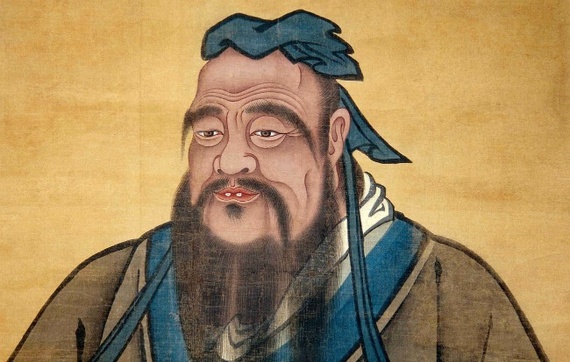
(Confucius as depicted in the Atlantic piece
What Confucius Teaches Us About Modern American Justice)


Asian Philosopher Tea Rubric
Name: __________________
Title: ___________________
(1=low, 5=high)
Prepared for tea at start time (e.g., nametag, materials ready)
Bibliography formatted correctly, contains scholarly sources, uploaded to http://www.turnitin.com
Evidence of research by bringing notes to class and referencing research during discussion
Engaged in discussion by stating views, challenging or building on others' views, clarifying questions
Listens while others are talking
Friday, January 15, 2016
Mandate of Heaven
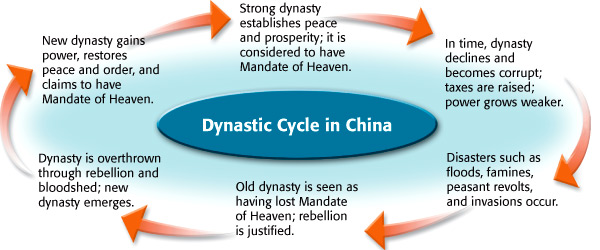
Today, we analyzed this version of the primary source, Mandate of Heaven. For those of you who were absent for MUN or hockey or just plain sick, I've uploaded the board pictures of our analysis below.


Finally, we briefly discussed a little about the veneration of the ancestor in ancient China. I showed two pictures of ancestor shrines I happened to see downtown last weekend. Following up on that, here is an online museum exhibition at the Smithsonian uploaded by some Chinese-American teenagers about ancestor worship today in Taiwan and in the United States. http://www.asia.si.edu/exhibitions/online/teen/


Finally, we briefly discussed a little about the veneration of the ancestor in ancient China. I showed two pictures of ancestor shrines I happened to see downtown last weekend. Following up on that, here is an online museum exhibition at the Smithsonian uploaded by some Chinese-American teenagers about ancestor worship today in Taiwan and in the United States. http://www.asia.si.edu/exhibitions/online/teen/
Wednesday, January 13, 2016


Subscribe to:
Comments (Atom)